How to Talk to Potential Clients
Calling leads is the fastest way to engage and build relationships, but what do you talk about?
We break it own into 2 parts - F.O.R.D to build rapport and market updates to give value.
Step 1
F.O.R.D Technique
FORD is an acronym that stands for Family, Occupation, Recreation, and Dreams.
This technique is meant to be incorporated into your conversations so you can ask the right questions to build trust and more meaningful connections.
Family
Most people have a family and consider them to be an important part of their lives. Even for people who do not have a traditional family structure, they typically have a community of support in its place. Family can even mean close friends and pets. Try starting with an anecdote to prompt a question.
For example, “I am looking forward to my daughter coming to visit this weekend. Do you have any children?”
Question examples:
Where did you grow up?
Where is your family now?
Do you have any pets?
How do you typically spend weekends or holidays as a family?
Now focus on their answers... ask more questions... sit back and listen.
The best situation is when the person brings up their family in conversation without being prompted. Now you have the perfect opportunity to ask more questions.
If they mention a child:
How old are your children?
Are your children in school, and if so, what grades are they in?
If they happen to be the same age as your child, you now have a perfect way to connect with them and discuss shared experiences.
If you already know a person and some of their family background, keep track of what they say and be thoughtful in future conversations. Ask how their partner/sibling/child is doing the next time you speak with them.
Just remember to stay away from invasive questions. For example, never ask whether someone is going to have children, when someone is going to get married or move in together, or why they are not close with family or a specific family member.

Occupation
Occupation is the easiest topic to bring up in a professional setting. If you are new to networking, talking about what someone does for a living is a given. It is pretty easy to start a conversation with,
What do you do?
How long have they been in that occupation?
What did you do before?
Now focus on their answers... ask more questions... sit back and listen
Although it is important to know what someone does, do not force the entire conversation to surround work. When building trusting and long-term relationships, their occupation should not be the only topic covered.

Recreation
Recreation includes everything you like to do outside of work. If you are looking to spice up a conversation, start by asking a simple,
How was your weekend?
If the question seems abrupt, weave a personal story into the conversation to lead into the question like,
I just got back from a trip to xxx to escape the cold weather for a bit. Do you like to travel?”
Other examples:
What do you do for fun?
What do you like to do in your free time?
Are you into any sports, either playing or watching?
Do you have any upcoming trips or travel plans?
Have you seen any good movies or TV shows recently?
Are there any concerts or theater performances you’re looking forward to?
Now focus on their answers... ask more questions... sit back and listen
Even if the person has completely different interests than you, this will make for better conversation. Get curious about their recreational hobbies and ask questions. In the end, they will appreciate your interest in them and will leave the conversation feeling more energised and valued.

Dreams
Everyone has dreams, whether it is about their career or different aspects of their life. For those of you who are not a fan of small talk, this topic can quickly lead into deeper, more meaningful conversations. Although, we recommend you reserve this topic for a later conversation with someone, not for a first introductory meeting.
An example could be
If you could achieve anything, what would it be?
What’s a personal goal you’re working towards right now?
If you could travel anywhere in the world, where would you go?
Do you have any dreams or goals for your family?
Where do you see yourself living in five years?
This usually leads into the perfect opportunity to offer your services.
Step 2
Market Updates - updated bi-weekly
Hot topic - UK sees house price growth
UK house growth has increased by 2.8% over the last 12 months
What does this mean?
The economic recovery, driven by declining inflation, has boosted confidence and positively influenced interest rates set by both the Bank of England and mortgage lenders. While many experts initially predicted a decline in house prices, the UK housing market has defied expectations and experienced significant price increases.
Economy
The Bank of England held interest rates at 5% in September, with an expectation that they may be cut in November.
Monthly GDP is estimated to have grown by 0.2% in August, after showing no growth in July (ONS).
CPI inflation rose by 1.7% in the 12 months to September, down from 2.2% in August (ONS).
What does this mean?
The key focus now is the pending budget. With an anticipated rate cut, we should see further reductions in mortgage rates, which will help boost transaction levels in the housing market. A GDP growth of 0.2% indicates that the economy is expanding and that spending is occurring across most industries. Inflation rates have dropped below expectations; while we are currently paying 1.7% more for products than we did last year, this increase is lower than predicted. The ideal inflation rate encouraged by the Bank of England is 2%, but compared to previous highs of 11%, we are in a much better position for a stable housing market, minimising the risk of boom and bust scenarios.
House Prices
The average price for a property in August was £292,924, up 2.8% year-on-year (ONS).
Average new seller asking prices rose by 0.3% this month to £371,958, much lower than the average seasonal 1.3% increase at this time of year (Rightmove).
A net balance of +54% of survey participants are of the view that house prices will increase over the next twelve months, the strongest reading since April 2022 (RICS).
What does this mean?
The lower-than-expected asking prices from new sellers indicate that the housing market is slowing down. While we believe this trend is dependent on the area, it still reflects a positive movement in prices, even if the market is slower. It's important to note that a lower asking price doesn't necessarily lead to a lower sale price; it may simply result in a quicker sale at the same price level.
Transactions
There were 90,210 transactions in August, a 5.4% rise compared to a year earlier (HMRC).
The agreed sales metric in the latest RICS' survey posted a net balance reading of +5%, similar to last month.
The number of sales being agreed is up by 29% year-on-year, a strong rebound from last year's weaker market (Rightmove).
What does this mean?
With fewer buyers in the market, transactions have remained stable. This indicates that while each property is attracting fewer inquiries, the quality of buyers is very strong. Transactions have now returned to pre-COVID levels, and current trends suggest a period of stability. This is precisely what is needed to boost confidence in the market.
Demand
There were 64,858 mortgage approvals in August which is 43% higher than a year ago (Bank of England).
The reading of new buyer enquiries in the latest RICS Residential Market Survey was +14%, marking the third successive report in which the indicator has returned a positive reading.
Home buyer demand is up 26% on this time last year (Zoopla).
What does this mean?
Demand, although lower than two years ago, is showing an upward trend, which should help protect house prices. With new construction falling short of requirements, the secondary market is being driven by increasing demand. Given the positive trends we are seeing, we predict that demand will continue to rise, leading to price increases over the next 12 months.
Forecasts
What does this mean?
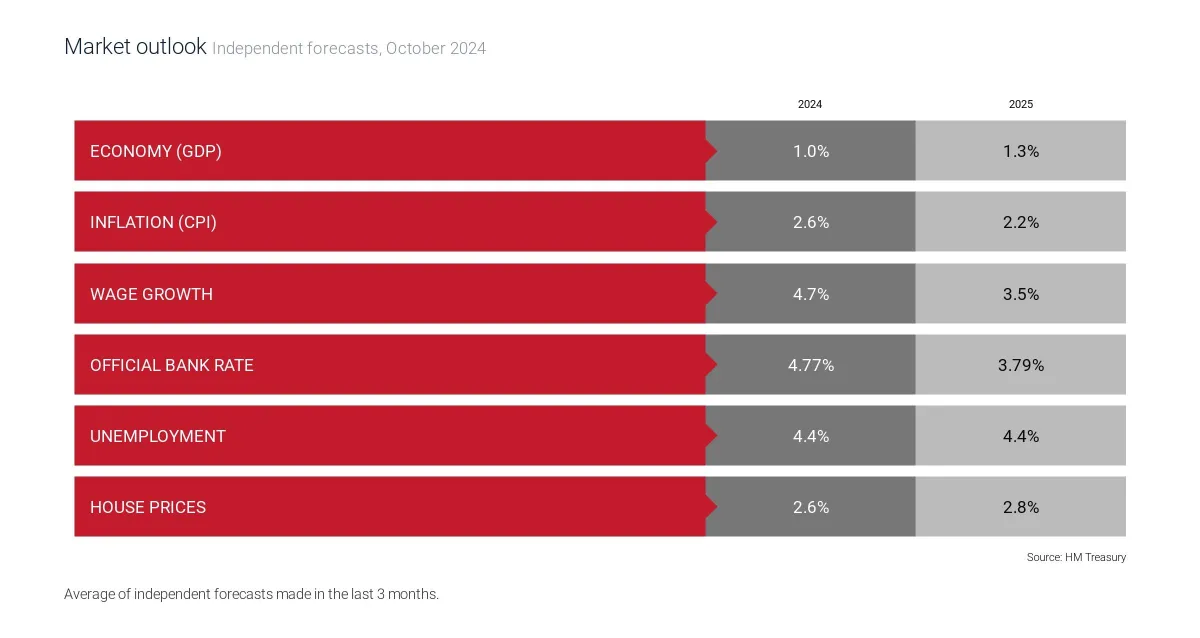
The current economic forecasts look very promising. The economy is expected to grow, inflation is projected to average at an ideal level, and interest rates are anticipated to drop below 3.8%. Unemployment is expected to stabilise rather than increase, and house prices are predicted to rise by 2.8%. The only downside is that wage growth is expected to decrease from 4.77% to 3.5%. However, this aligns with the lower cost of living, meaning it remains above the forecasted inflation rate. Overall, the outlook for the housing market is positive.